
Showing posts with label Karen Nicholson. Show all posts
Showing posts with label Karen Nicholson. Show all posts
Sunday, May 7, 2017
Follow by Email Gadget
I added the Follow by Email gadget because this is the way I prefer to follow blogs. There is so much interesting content available that I find it difficult to remember to visit the blogs and sites that I enjoy. I much prefer to receive an email that there is a new post at a favorite blog. It is like receiving a surprise gift in my inbox. 🎁 😃

Tuesday, April 25, 2017
Libraries and Student Success
Libraries and Student Success
by Karen Nicholson
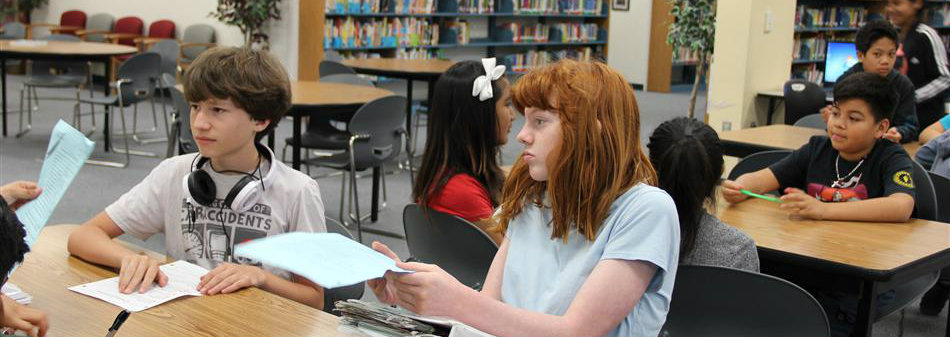
http://www.smusd.org/cms/lib3/CA01000805/Centricity/ModuleInstance/16147/large/IMG_6885.jpg?rnd=0.929442089483813
Libraries are a major component of student success. I found it surprising in my research on this topic that it has been shown that students writing scores improved more than their reading skills when they have access to a library with a full time librarian (Kachel and Lance). Well staffed libraries are even more important for struggling students. They will have the most improvement if given the resources of the library and a librarian who is willing to teach them and find them reading materials they enjoy. One of my favorite things as a middle school librarian is helping a student finding a book they enjoy. Just last week I had a 6th grader come up to me and let me know that he was really enjoying the book I suggested. He came back the next day, returned the book, and asked for the next one in the series. SUCCESS!! 🎆 Now he has experienced how much fun it can be to read, and he will hopefully trust me to ask again for help to find a book in the future. I had another student check out a book in the morning and she returned after school, triumphant, she had read the entire book that day! (Although I wonder what her teachers reactions were to her reading throughout class. She is a good student, so I am guessing she was already done with her class work.)
Studies have even shown that it does not matter what the local economic situation is, having a qualified school librarian will always increase reading and writing scores (Lance and Hofschire 19). This shows it is just as import to have qualified librarians where the districts can “afford” them and in the districts that are having major budget cuts.
It is important that schools and school librarians continue to track and study their students success as it relates to the library. There is data out there, but we need to make sure it is current and relatable. The librarians need to use this information to prove the incredible importance of their job for their school and community. Self-assessments are important for so many reasons: to make sure lessons and collections are up to date, to make sure teachers are utilizing their resources, and to make sure student scores are improving. As Lance and Kachel pointed out in their article there is a need for more large scale studies (13). This should be at a district-wide, state-wide and nation-wide level. But most importantly, in my opinion, they remind us that school administrators need to discuss their support of libraries and librarians to the teachers, staff, students and parents (13). Their support makes a huge difference in the success of the library at that school. I am lucky that I feel supported by the administration at my school. They are willing to listen to me and support my needs within the school environment.
Kachel, Debra E. and Keith Curry Lance. "Librarian Required." School Library Journal, vol. 59, no. 3, Mar. 2013, p. 28. EBSCOhost, ezproxy.palomar.edu/login?url=http://search.ebscohost.com/login.aspx?direct=true&db=aph&AN=85881651&site=ehost-live&scope=site.
Lance, Keith Curry and Linda Hofschire. "School Librarian Staffing Linked with Gains in Student Achievement, 2005 to 2011." Teacher Librarian, vol. 39, no. 6, Oct. 2012, pp. 15-19. EBSCOhost, ezproxy.palomar.edu/login?url=http://search.ebscohost.com/login.aspx?direct=true&db=aph&AN=82862803&site=ehost-live&scope=site.
Lance, Keith Curry and Debra Kachel. "Achieving Academic Standards through the School Library Program." Teacher Librarian, vol. 40, no. 5, June 2013, pp. 8-13. EBSCOhost, ezproxy.palomar.edu/login?url=http://search.ebscohost.com/login.aspx?direct=true&db=aph&AN=88257486&site=ehost-live&scope=site.
Libraries and the Homeless
by Karen Nicholson

Homelessness is an important issue for all libraries. I have mostly seen articles and discussions that focus on public libraries and their homeless population. They talk about the rules that are in place, sometimes to keep the homeless out of the library, which often includes not being allowed to sleep in the library and not being allowed to stay if they have a strong odor. One way to help this population is to bring mobile showers to the library site and allow the homeless to use it and basic supplies for free. According to Ruhlmann, this has already happened within the San Francisco Public Library system (43). Another way to get around strict rules and regulations within the library, that may not be enforced fairly across the board is to stick to one rule: “If you’re doing something that interferes with someone else’s use of the library it is not allowed” (Ruhlmann, 42).
Homelessness is also a very important issue for school libraries. I work in a public middle school library and I know that there are several students within the school’s population that are homeless. I do not know exactly who they are, nor do I try to search them out. Instead, I try to make the library as welcoming and safe for all students. I try to enforce all of my rules fairly and across the board. I also try to make as many connections as possible with the students that visit me. I will take the time to chat with a student when they are visiting the library and try to say hello to familiar faces when I seem around campus. I have a large number of students that visit the library before school. Most are sitting at tables talking to friends and checking their phones. All 10 of my computers are filled with students playing games and interacting with their friends. At least 5 of the computers have 3 or 4 boys crowded around watching what the others are doing. (We have a computer lab that is open before school for homework.) I usually have several tables with students finishing homework or reading books. If I see someone breaking the rules I ask them to leave, but tell them, every time, that they are welcome back, either at lunch or the next day, depending on the severity of the incident. “School, especially the school library, may be the only thing a homeless student can count on as a place that is safe, comfortable, and full of books, magazines, online resources, and more that can bring enjoyment and respite from the daily stresses of his or her life” (Adams, 53).
It is important for all students to have access to books and textbooks, especially if they are homeless. School libraries should try to be flexible when it comes to their homeless students. They should still be allowed to check out books to be used away from school. If the books are not returned, and a reason is given (like they no longer have access to the books), their fines should be waived and allowed to continue to having access to books and checking them out. According to Adams, school librarians need to keep in mind that it is not the student’s fault for no longer having access to a book (53). It is also important to make sure there are current, quality books in the library about the homeless, especially relating to children.
Here is a video on successful student who was a homeless high school student:
Sources:
Adams, Helen R. "Serving Homeless Children in the School Library -- Part 1." School Library Monthly, vol. 27, no. 3, Dec. 2010, pp. 52-53. EBSCOhost, ezproxy.palomar.edu/login?url=http://search.ebscohost.com/login.aspx?direct=true&db=aph&AN=55620520&site=ehost-live&scope=site.
"Attending School As A Homeless Child." YouTube. Stories by Stassy, 1 Apr. 2015. Web. 25 Apr. 2017.
Ruhlmann, Ellyn. "A HOME to the HOMELESS." American Libraries, vol. 45, no. 11/12, Nov/Dec2014, pp. 40-44. EBSCOhost, ezproxy.palomar.edu/login?url=http://search.ebscohost.com/login.aspx?direct=true&db=aph&AN=99206614&site=ehost-live&scope=site.
Social Networking and Libraries
Social Networking and Libraries
by Karen Nicholson

I follow a lot of libraries and similar groups online at Facebook, Twitter, and Instagram. I love how funny they can be and how they can connect books and reading to so many other activities and ideas. I think that social media is an important tool that every library can utilize. It is a way to connect and interact with their patrons, especially with younger patrons like teens and young adults. I love it when libraries ask what people are currently reading. This gives the other followers a chance to see what books patrons are interested in and maybe try out some new books to read.
According to Buono & Kordeliski, social media is a great way to provide transparency, engagement and exposure for libraries (30). Transparency allows you to show your users how you are using funds in the library and why. You can show off new book purchases, talk about staff members, or any big ticket items you purchased for the library. Engagement helps you to connect with your patrons and hopefully get them to physically visit the library. Social media is great way to engage and interact with teens at a public or school library. You can help them feel included in what is going on in the library. Exposure allows you to get support and bring in other people who may be interested in what the library has to offer. “It creates a new space for libraries to have value. Beyond their four walls. -Jeremy Graybill” (Dankowski, 41)
It is really nice that there are so many types of social media now, and they can be used in different ways, and all are useful for libraries. Facebook is great to let your patrons know of upcoming events or contests. It is also good for longer posts with more information. Twitter is good for quick updates. A place to showcase stuff that is going on at the moment that patrons may be interested in. You can really build a conversation with younger patrons using Twitter. Find a way to include a fun hashtag that they would want to add to. Instagram is a great way to invite patrons to see what goes on in and around the library. The library can showcase new books and some behind the scenes activities. Snapchat is another way to connect with younger patrons via images and videos. It is similar to Instagram except that the posts only stay up for a limited time. Pinterest is a platform mainly used by women and would be a good way to increase interaction with that population. You can create a board featuring new books, fun book covers, or even unusual titles.
One thing to keep in mind is that it is important to change what you post on different platforms. I often follow libraries and users on 3 different platforms and if the posts are the same on each I am really bored seeing it the third time. Keep in mind the strengths of each social media platform before you post. If it is an event or time sensitive post, switch it up a little for each platform to make it interesting.
Want to check out the San Marcos Middle School Library Instagram? You can find it @smmslibrary
Sources:
Buono, Michael P. and Amanda Kordeliski. "Connect, Create, Collaborate." Young Adult Library Services, vol. 11, no. 2, Winter2013, pp. 30-40. EBSCOhost, ezproxy.palomar.edu/login?url=http://search.ebscohost.com/login.aspx?direct=true&db=aph&AN=85125538&site=ehost-live&scope=site.
Dankowski, Terra. "How Libraries Are Using Social Media." American Libraries, vol. 44, no. 5, May 2013, pp. 38-41. EBSCOhost, ezproxy.palomar.edu/login?url=http://search.ebscohost.com/login.aspx?direct=true&db=aph&AN=87453442&site=ehost-live&scope=site.
Libraries as Social Hubs
Libraries as Social Hubs
by Karen Nicholson

I am the librarian at San Marcos Middle School. I want my school library to be thought of as a fun and safe place in the school. I want it to be a place to read a book, play a video game, socialize with friends, do some homework, or play a tabletop game. I want it to be a refuge for the kids that need a place to just be themselves. This library is not the shushing and be quiet type, unless it is reading time during class library visits or homework time after school. The most popular games in our library are UNO, chess and checkers. I love it when a student asks me to play a game of UNO with them. It gives me a chance get to know the students better, have some fun, and make new connections with the students that inevitably join our game.
I’m almost at the end of my first year as the library media technician at San Marcos Middle School. I am absolutely loving my job and I am looking forward towards what I would like to add to the library in the next few years. The first is to start a book club. I know of several teachers that are also interested in this, and I would happily host it in the library. We could read a book every few weeks and meetup to talk about it. I would want the students to have input on what books we read, and maybe have them each take a turn suggesting a book. I would also like at least one period of time to have each student to read different books they are interested in and let the other students know why they picked it and what they thought about it.
The other activity I would like to start up in the library would be a tabletop gaming group. I am a gamer, I LOVE to play video games and to play analog tabletop games with my friends and family. I find video games to be a solo adventure for me, but tabletop games are very social and a great way to build relationships with friends. Almost every weekend I get together with some friends and we play a tabletop game. We often re-play our favorites and enjoy trying out new games. There are so many great games out there that would be fantastic to play in a middle school library. So many students are playing games on their phones, or on the computers in the library. I would like them to get more involved in playing games with each other. According to Alvarez, “modern tabletop games have been proven more engaging than many of the older games, but they also have been proven to leave fewer feelings of resentment or discouragement if gaming outcomes are not favorable. In fact, students leave the table strategizing better outcomes and looking forward to the next challenge” (42). These games go beyond the luck factor of popular older games like Monopoly or Risk. There are many modern games that use more cooperation, include more variety in decisions needed to be made to be successful, and have less waiting between player turns (Alvarez, 45). Using a cooperative game like Forbidden Island can be a way for students to feel successful, but not the pressure to having a goal of defeating their opponent (Alvarez, 45). They can work on their teamwork skills, while having a lot of fun. Every student that is playing can give important input on the best way to win the game. When I start up this group I plan on starting with Ticket to Ride and trying other games after that. Based on the games I have played with my friends over the last several years I would recommend the following to try with students in a library setting: Carcassonne, Descent, Dominion, Fluxx, Bang!, Forbidden Island, Legendary, Machi Koro, Mysterium, Pandemic, Qwirkle, Sushi Go!, Settlers of Catan, Takenoko, Ticket to Ride, Tokaido
Alvarez, Vivian. "Engaging Students in the Library through Tabletop Gaming." Knowledge Quest, vol. 45, no. 4, Mar/Apr2017, pp. 40-48. EBSCOhost, ezproxy.palomar.edu/login?url=http://search.ebscohost.com/login.aspx?direct=true&db=lxh&AN=121512460&site=ehost-live&scope=site.
BoardGameGeek. N.p., n.d. Web. 25 Apr. 2017.
BoardGameGeek. N.p., n.d. Web. 25 Apr. 2017.
Subscribe to:
Posts (Atom)