Showing posts with label Libraries and Student Success. Show all posts

Friday, April 28, 2017

Liraries and Student Success

Libraries have long had a connection with learning and literacy and have been a vital part of the communities educational goals, especially when it comes to youth and a love for the knowledge that comes along with books and reading.  When libraries take this connection to the next level and look for ways to help youth succeed beyond literacy and engage in homework help and after school programs they create a true connection to their communities that goes beyond just books and into the "it takes a village" mantra.  Creating a place where families and community members will come back from generation to generation.

San Diego has taken a hold of this mantra through Mayor Faulconer's 2014 coalition to expand library services in the city to include after school programs that help K-8 students with homework in a supportive environment, with the materials and tutors needed to help them succeed.  

Check out the article below outlining the programs mission and goals:


Thursday, April 27, 2017

Libraries and Student Success

Libraries and Student Success

by Jennifer Ellis


Long gone are the days of the sterile school library. I remember when I was my daughter's age, we were shushed and shuffled out of the library as soon as we found our requisite weekly books. We did make occasional trip for research, but we had to slog through the seemingly endless card catalog, only to find that the book was missing. Honestly, I don't remember too many interactions with my school librarians, other than that one time we made Mrs. Schroeder cry.

These days, the school library is a dynamic learning arena. Yes, ARENA. One can accomplish so many different tasks at a library these days it's a wonder kids even go home for dinner. These places are set up for life-affirming success on all levels. The library at my daughter's school has a Junior Librarian program in the morning before classes start. Fifth grade students volunteer their time to help younger students find books, gain access to the computers, and sometimes help with homework. It provides a quiet, peer based experience that the students appreciate, and also helps our librarian. Our middle school has an after-school 'homework hour', which provides children with an opportunity to engage in learning without the distraction of siblings or after-school activities such as soccer or dance. Also, especially with the adoption of the Common Core Curriculum, our librarian now coordinates her lessons with state standards that are being taught in the classroom; there is more planning and teamwork among the grade-level teams and our librarian. What the kids are learning in the classroom is now being bolstered and supported by the librarian's contributions. "Overwhelmingly, studies show an undeniable, measurable connection between a quality school library program and increased student academic performance (Scholastic, 2006)."

The role of the school librarian has also shifted in recent years due to the ushering in of the digital age. When I was younger, I was sent off into the wilds of the stacks to find my own darn books; now with the push for information literacy, librarians are not just motioning toward the back of the building, they are showing us how to use an OPAC. They are leading a reference interview and teaching us how to navigate online databases and special collections. A librarian is now schooled in the ways of the digital media world, not just the Dewey Decimal System, so they are employing a whole new toolbelt of skills to ensure that students succeed. 

References

Scott, K. J., & Plourde, L. A. (2007). SCHOOL LIBRARIES AND INCREASED STUDENT ACHIEVEMENT: WHAT'S THE BIG IDEA?. Education, 127(3), 419-429.

Libraries and Student Success

Darla Mulder
analysis happy data children: education, elementary school, learning, technology and people concept - group of kids with teacher looking to tablet pc computer in classroom and virtual screen projection
LIT 130
April, 2017

Most people who use the library are there for a good reason. Weren't you? I was. Always to get a book, meet someone for a study hour, return a book, ask a librarian for help, sit and daydream while waiting for my mom to pick me up.

Pretty simple. I never thought about the library ever becoming critically analyzed in how much it benefits the users.

But did you ever think there would come a day when people would wonder and measure how much the library actually contributes to a student's success?  

How much can a library help a student achieve success in school? Many parents and teachers today speak highly of library use.  But can any of them show a spreadsheet chart on the amount of educational growth being  contributed...either in one library user?  That is a lot of data right there, imagine a collective measurement on all the users!

 Certainly, whenever there is a change in learning and retention, people would like to know the factors.  For decades, a library  has offered students a place to read, borrow and research.  Now people wonder how much it contributes to student success, and thus administratively measured.

It appears that to be funded, more data needs to be reported.  Gathering information about student success and libraries (a broad issue) one needs to consider which levels of students to focus on, how to construct a plan, a rubric, an outcome score and much much more!   

Many thoughts of student success, measurement, and funding were briefly articulated in the below articles.

It appears there are discussions about a variety of libraries' contributions toward student success, even if not classified as an academic library.  Questions range from the structure (or ambiance) of the building to the quality of the material, socioeconomic areas, ages,  the ease in operation of the technology, the interface with schools and community, and the ability of the staff to know exactly what the student needs in order to succeed.

Most workers in education during the past decade know it is an age of assessment and accountability.  The pressure that libraries are under is to prove their value according to new university measurements of student success, according to an A. Thorpe article called "Connecting the Dots. Portal: Libraries & the Academy."  The article discussed a study describing a methodology.  The libraries need to know what is being examined, how a student relates to their services and how the usage impacts grade point averages.  

Many want to correlate library usage (by some percentage weight or manner) with retention rates. 

Future funding stresses whether or not a student drops out of courses because they are not being helped or guided by teachers, staff and librarians.

Here is a You Tube video that raises interesting points about library usage and student success. The library is comparing the extracurricular activity (physical involvement) of a student. It is quite interesting. It discusses self efficiency.


 Usage data were collected at six library service points during the 2013-2014 academic year according to Thorpe. Many of the findings demonstrate the value of the academic library .  

 You have to Blow Your Own HORN!!

The article written by Hess in "Books, Bytes, and Buildings: The Academic Library's Unique Role in Improving Student Success" described how one independent library embraced cross-campus programs, partnerships, and initiatives to contribute to student success efforts.   


If students know the library is there for them, they might use it.  The responsibility belongs to the library to promote itself.


Free, D. (2016, June). ACRL reports shows compelling evidence of library contributions to student                                      learning and success. College & Research Libraries News, 77(6), 271-271. Retrieved April                                24, 2017, from Academic Search Premier.

Nichols Hess, A., Greer, K., Lombardo, S. V., & Lim, A. (2015, November). Books, Bytes, and Buildings:                         The Academic Library's Unique Role in Improving Student Success. Journal of Library                                     Administration,   55(8), 622-638. doi:10.1080/01930826


Spencer, M. E., & Watstein, S. B. (2017, April). Academic Library Spaces: Advancing Student Success                              and Helping Students Thrive. Portal: Libraries & the Academy, 17(2), 389-402. Retrieved                                April 24, 2017, from            Academic Search Premier.
                     Accession Number: 122412900


Thorpe, A., Lukes, R., Bever, D. J., & He, Y. (2016, April). The Impact of the Academic Library on                                    Student  Success: Connecting the Dots. Portal: Libraries & the Academy, 16(2), 373-392.                                  Retrieved April 24, 2017, from Academic Search Premier.


Wednesday, April 26, 2017

Libraries and Student Success
By Sara Rodriguez

Throughout the years libraries have been a big part of student successes. It seems that they don't get enough recognition for the success they provide to students. The Washington Library Media Association conducted a study using 1,486 K-12 public schools, the results demonstrated that students who attended schools that had a certified librarian as well as a quality library performed better on standardized test by almost 8%. The results are due to the fact that these certified librarians have the resources to assist children in a productive way. For instance, in my years in high school our school library was a very helpful place for me. The librarian always had resources in hand to help me when i lacked understanding, and if they didn't have the specific information i was looking for they would direct me to help outside of the library. This was a major component of my success in high school, without this help i would have been lost and not known where to acquire this information. It seems though that schools don't put enough emphasis on the library, they believe that these students receive all the education they need in the classrooms. Studies challenge this way of thinking, as they have been  proven that libraries can have an impact on a student's educational skills.

Libraries have technology and resources available to aid students in their education. These technologies can be of great help for students living in poverty. In m y opinion this is one of the biggest ways libraries can help because many people believe that students who are poorer are set to have poor grades in school. Studies have proven this to be wrong though as a study conducted by the PSLA showed that the five year graduation rate is 78.8 percent in schools that have certified librarians, while it is 43.2 percent at schools without. This study was conducted on  high schools that have a high percentage of poverty students. This clearly demonstrates that students with a lack of resources and money benefit immensely for this type of help.  As Kachel and Lance state “Consistently, reading and writing scores are better for students who have a full-time certified librarian than those who don't. Students who are economically disadvantaged, black, Hispanic, and have IEPs benefit proportionally more than students generally”. These results further prove that libraries can help with the student  achievement in school and help close learning gaps due to poverty.


Sun, C. (2015, May 26). Washington Study Further Ties Quality Library Programs to Student Success. Retrieved April 27, 2017, from http://www.slj.com/2015/05/research/washington-study-further-ties-quality-library-programs-to-student-success/

Kachel, Debra E. and Keith Curry Lance. "Librarian Required." School Library Journal, vol. 59, no. 3, Mar. 2013, p. 28. EBSCOhost, Kachel, D. E., & Lance, K. C. (2013). Librarian Required. School Library Journal, 59(3), 28.

Tuesday, April 25, 2017

Libraries and Student Success

Libraries and Student Success
by Karen Nicholson
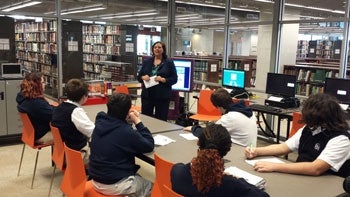
IMG_6885.jpg
http://www.smusd.org/cms/lib3/CA01000805/Centricity/ModuleInstance/16147/large/IMG_6885.jpg?rnd=0.929442089483813
Libraries are a major component of student success.  I found it surprising in my research on this topic that it has been shown that students writing scores improved more than their reading skills when they have access to a library with a full time librarian (Kachel and Lance).  Well staffed libraries are even more important for struggling students.  They will have the most improvement if given the resources of the library and a librarian who is willing to teach them and find them reading materials they enjoy.  One of my favorite things as a middle school librarian is helping a student finding a book they enjoy.  Just last week I had a 6th grader come up to me and let me know that he was really enjoying the book I suggested.  He came back the next day, returned the book, and asked for the next one in the series.  SUCCESS!!  ðŸŽ† Now he has experienced how much fun it can be to read, and he will hopefully trust me to ask again for help to find a book in the future.  I had another student check out a book in the morning and she returned after school, triumphant, she had read the entire book that day!  (Although I wonder what her teachers reactions were to her reading throughout class.  She is a good student, so I am guessing she was already done with her class work.)  
Studies have even shown that it does not matter what the local economic situation is, having a qualified school librarian will always increase reading and writing scores (Lance and Hofschire 19).  This shows it is just as import to have qualified librarians where the districts can “afford” them and in the districts that are having major budget cuts.
It is important that schools and school librarians continue to track and study their students success as it relates to the library.  There is data out there, but we need to make sure it is current and relatable.  The librarians need to use this information to prove the incredible importance of their job for their school and community.  Self-assessments are important for so many reasons:  to make sure lessons and collections are up to date, to make sure teachers are utilizing their resources, and to make sure student scores are improving.  As Lance and Kachel pointed out in their article there is a need for more large scale studies (13).  This should be at a district-wide, state-wide and nation-wide level.  But most importantly, in my opinion, they remind us that school administrators need to discuss their support of libraries and librarians to the teachers, staff, students and parents  (13).   Their support makes a huge difference in the success of the library at that school.  I am lucky that I feel supported by the administration at my school.  They are willing to listen to me and support my needs within the school environment.
Kachel, Debra E. and Keith Curry Lance. "Librarian Required." School Library Journal, vol. 59, no. 3, Mar. 2013, p. 28. EBSCOhost, ezproxy.palomar.edu/login?url=http://search.ebscohost.com/login.aspx?direct=true&db=aph&AN=85881651&site=ehost-live&scope=site.
Lance, Keith Curry and Linda Hofschire. "School Librarian Staffing Linked with Gains in Student Achievement, 2005 to 2011." Teacher Librarian, vol. 39, no. 6, Oct. 2012, pp. 15-19. EBSCOhost, ezproxy.palomar.edu/login?url=http://search.ebscohost.com/login.aspx?direct=true&db=aph&AN=82862803&site=ehost-live&scope=site.

Lance, Keith Curry and Debra Kachel. "Achieving Academic Standards through the School Library Program." Teacher Librarian, vol. 40, no. 5, June 2013, pp. 8-13. EBSCOhost, ezproxy.palomar.edu/login?url=http://search.ebscohost.com/login.aspx?direct=true&db=aph&AN=88257486&site=ehost-live&scope=site.

Monday, April 24, 2017


Libraries and Student Success
By Lori Schafer


My fondest memories of school from elementary to middle school, and then high school to college were my experiences reading, learning and just hanging out in the library. For me the two, schools and libraries, are inseparable and I think they are both equally important in
11 Reasons Libraries are the Best Places to Hang Out:

https://www.bustle.com/articles/118607-11-reasons-
libraries-are-the-best-places-to-hang-ou
t
shaping students academic lives. It struck a chord when I read a passage in the article Building Success beyond High School with Career– and College-Ready Literacies that “School librarians make it a priority to create an environment in which students feel safe, welcome, and supported. We can help students take that feeling of safety and security with them as they move into adult spaces, including university and public libraries” (Foote, 2016, p. 57). We naturally assume that schools are responsible for our overall education and forget that libraries have contributed so much in developing our educational skills and continue to do so throughout our lifetimes.

With the advancement in technology and the digital presence in everyday life, libraries are in a position to help students learn these technological skills and feel comfortable in the digital environment especially since this knowledge is critical at the university level. Foote also mentions in her article in addition to digital training the “school librarians can talk to students about appropriate use of social media accounts as they move into college or careers or show them how to create alternate accounts for professional work. In fact, students are already unconsciously sorting their online identities” (Foote, 2016, p. 60). Libraries are in a unique position with the complete array of technology, digital platforms, social media, etc. to teach students digital literacy and technology that will help them transition successfully into college and beyond into being life-long learners.

However, today with the budget cuts to the school library programs and positions it is difficult for libraries to achieve success under already lean circumstances. As noted in the article Promote, Lead, & Refuse: Librarianship in Tough Times, “The reason to stand up for school library programs and staffing is that, without them, there is no reliable way to communicate the multiple literacies needed by our learners for tomorrow's post-secondary education and future careers” (Martin, 2009, p. 7). Libraries have to defend their worth for budgetary reasons and continuously communicate to the public the valuable connection between libraries and student success. More then ever with the digital age and their need to redefine their roles in the 21st century, libraries need to be defended and supported by the community to ensure students are successful and are prepared for the future.


References
Foote, C. (2016). Building Success beyond High School with Career- and College-Ready Literacies. Knowledge 
     Quest
, 44(5), 56-60.
Martin, A. M. (2009). Promote, Lead, & Refuse: Librarianship in Tough Times. Knowledge Quest, 37(4), 6-10.


Tuesday, April 18, 2017

University Libraries: Empowering Students to Succeed

________________________________________________________________________________________________

Image 1: Students in Library
University Libraries: Empowering Students to Succeed
By Jessica Sparks

Libraries are constantly evolving to meet the needs of technology and its community, and University Libraries are no different. Changes in technology, in research, teaching and learning all have an impact on the missions of academic and research libraries.

University libraries have to be many things for students. They are the center of the student's college life. Most students live on or very near to the campus and spend late nights, early mornings, long days, and even weekends studying in the library. The library  is also the center of the campus community, including graduate students, professors, and visiting scholars. The library must also meet the needs of the outside community who use the library resources, attend library events, and visit the college special collections and exhibits. To meet the needs of everyone, university libraries must be active in creating new programs and offering resources that are essential to the students. University Libraries go above and beyond to meet the needs of its students and support them. The video below is of Temple University Library's Finals Week: Therapy Dogs:

University libraries are always acting with the students in mind from the design of the building to even extending the library hours to meets the needs of its students during the middle and end of the quarter/semester. While a working at the UCSB Library as a student, I was given hundreds of blue books to hand out to students as they walked through the library along with candy. Many university libraries partner with campus programs like Health Services to prove students with stress relief activities:
  • The University of California, Santa Barbara Library co-hosts a “Study Breaks” with Health Services that includes chair massages, puzzles, coloring books, a stretching station, tea and healthy snacks.
  • The Cal State University, San Marcos has a “Crunch Time” snack cart that roams around the library during midterms and finals.
  • The Florida State University Libraries had a 90's themed De-stress Week with Lego's and other activities.
  • Stanford University Libraries brings dogs on campus for a De-Stress event.

Image 2: Stanford University Libraries De-Stress Event
Libraries have a direct impact on the well-being and academic success of students. Whether a student needs a quiet place to study, find that source they need for their paper or sit and ready between classes, the library is a space where students can go. Recently, many university libraries have undergone renovations and expansions to create a space that better suits its students and allows them to succeed. Some of the additions are not only space but new technology. In a study done by the Association of College and Research Libraries on the contributions of academic libraries and student success, it was found that a library’s research and study space has an impact on students, and overall library instruction contributes to students’ confidence, persistence, and achieve higher grades (Association of College and Research Libraries). The design of the library, the study rooms, study spaces, and library classrooms, are just some of the ways in which the students’ needs determine the space of the library.

________________________________________________________________________________________________


References

Karen, B., & Malenfant, K. J. (2015, January). Academic library contributions to student success: Documented practices from the field. Retrieved April 26, 2017, from http://www.ala.org/acrl/sites/ala.org.acrl/files/content/issues/value/contributions_report.pdf

Finals week: Therapy dogs take students' stress away [Video file]. (2013). Temple University Library. Retrieved April 26, 2016, from https://www.youtube.com/watch?v=dJu34FZlS6M.    

[Stanford De-Stress Fest Dog Petting.]. (n.d.). Retrieved April 26, 2017, from library.stanford.edu/news/2014/11/de-stress-fest

[Students in Library.] (Feb 25, 2015). Retrieved April 26, 2017, from www.lrs.org/2015/02/25/5521/.